


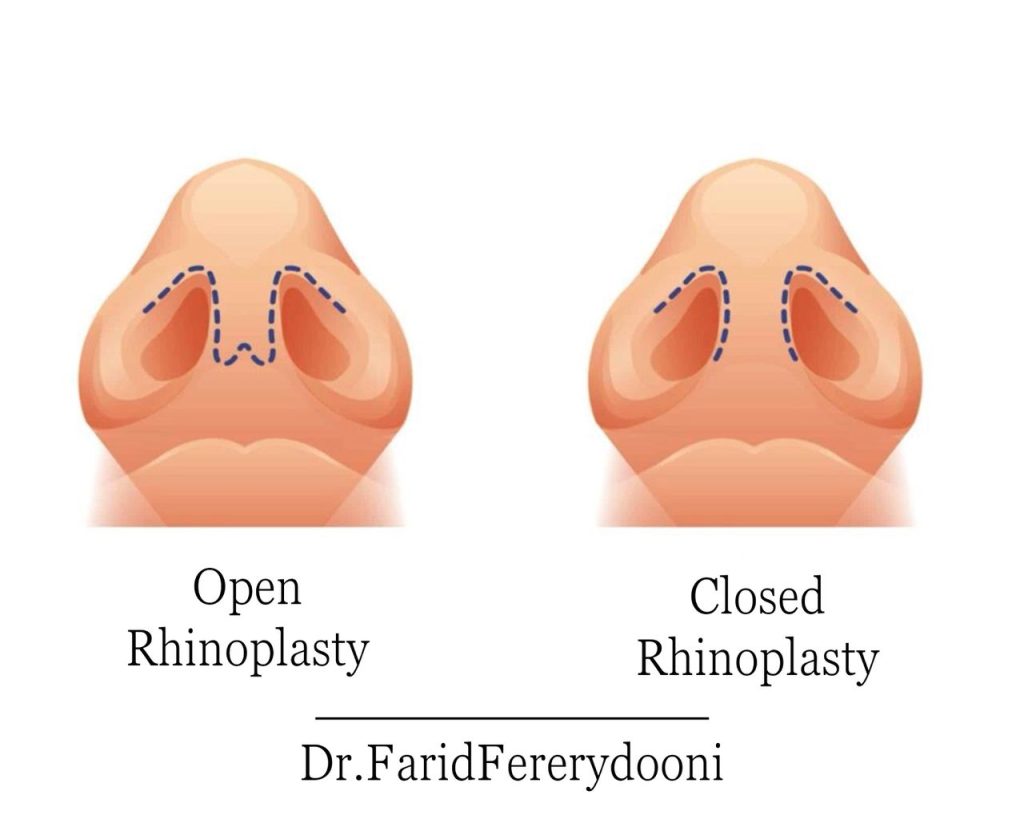
Closed Rhinoplasty Surgery | Precision in Technique, Accuracy in Results
Closed rhinoplasty surgery is a modern and minimally invasive approach in rhinoplasty that is performed with the goal of achieving maximum precision, minimal tissue damage, and the shortest recovery period
In this technique, all incisions are made inside the nose and no incision or suture is created on the skin (columella area); therefore, there will be no external
scar or wound mark
Advantages of Closed Surgery
Short recovery period (about one week)
No use of tampons
Short duration of nose taping (about three weeks)
Significant reduction in pain, bruising, and swelling
Faster return to daily activities
Specialized Approach in Revision Surgery
Dr. Farid Fereydooni, as the first surgeon to perform revision rhinoplasty using the closed method together with rib cartilage
has introduced a unique approach
In this technique, a very delicate incision (about 2 to 3 centimeters) is made in the area under the breast and the required cartilage is harvested
this process has no connection to the rib itself and is usually performed without pain or any significant recovery period
Difference in Quality
Due to the sensitivity and delicacy of this method
only a limited number of patients are accepted daily so that maximum time, precision, and quality can be provided for each surgery
To view additional explanations and revision surgery samples, you can follow the gallery section on the website or the revision rhinoplasty highlight on Instagram
Difference Between Open and Closed Surgery
Any change that is possible in open surgery can also be performed in closed surgery, but the advantages of closed surgery are greater because the columella is not cut
The lymphatic vessels are preserved and blood circulation is not interrupted; whether for nasal changes or when the nostrils are cut, reduced blood supply or nasal necrosis becomes less likely
Because the ligaments and connective tissues are not separated from the columella, there will be no post-tip supratip deformity or drooping after several years
The swelling after surgery is less and subsides faster in closed rhinoplasty
The duration of nose taping, pain, and bruising in closed surgery is much less
and as a result these factors play a major role in the beauty and delicacy of the
nose
The Difference Between Open and Closed Rhinoplasty
Choosing between open and closed rhinoplasty is one of the most common questions for individuals considering rhinoplasty or even revision nose surgery.
Each of these methods has its own techniques and applications, but today, with the advancement of modern rhinoplasty techniques, the closed and (Preservation) approach has gained significant attention
Dr. Farid Fereydooni, a plastic surgery specialist, focuses on natural rhinoplasty and modern closed rhinoplasty techniques. In many primary and even revision surgeries, he uses this approach to create a more natural and minimally invasive result
What Is Closed Rhinoplasty?
In closed rhinoplasty or (Preservation), all incisions are made inside the nose and there is no external incision. In this method, the natural nasal tissues, ligaments, and blood supply are completely preserved, which helps reduce swelling, bruising, and inflammation after surgery
In modern (Preservation) techniques performed by Dr. Farid Fereydooni, the goal is not simply to make the nose smaller; rather, it is to preserve facial harmony and create a natural and long-lasting result
Advantages of Closed Rhinoplasty
No external incision on the nose
Less swelling and bruising
Better preservation of blood supply and natural tissues
Easier recovery period
Preservation of natural facial appearance
Reduced possibility of nasal tip drooping over time
Faster return to daily activities
Is Revision Rhinoplasty Possible with the Closed Technique?
Contrary to what many people believe, in some cases revision rhinoplasty can also be performed using the closed technique.
Dr. Farid Feredooni in many revision nose surgeries, uses advanced techniques and, when needed, rib cartilage to improve both the shape and function of the nose without causing additional damage to the nasal structure
The use of rib cartilage in revision rhinoplasty is usually necessary when the nose no longer has enough structural support due to previous surgeries or when structural reconstruction is required
Is Open or Closed Rhinoplasty Better?
The reality is that there is no single method suitable for everyone. Choosing the right technique depends on the shape of the nose, skin type, internal nasal structure, history of previous surgery, and the type of changes needed
However, today many patients are looking for a more natural result, an easier recovery, and preservation of the natural nasal structure; this is why closed rhinoplasty and (Preservation) have become among the most popular modern rhinoplasty techniques
Dr. Farid Fereydooni`s goal in rhinoplasty is to create natural balance and harmony in the face, whether in primary rhinoplasty or complex revision surgeries
Recovery Period After Closed
Rhinoplasty with Dr.FaridFereydooni
One of the most importa nt concerns for people considering rhinoplasty is the recovery period after surgery. Many still imagine rhinoplasty as involving nasal packing, heavy casts, severe bruising, and long-term limitations, whereas with modern closed rhinoplasty techniques, the post-operative experience has become much easier than in the past.
Farid Fereydooni, a plastic surgery specialist, focuses on natural rhinoplasty, modern Preservation techniques, and closed rhinoplasty methods, aiming to make the recovery period as light, comfortable, and hassle-free as possible for patients.
In this method, there are no external incisions or stitches on the nose, and all changes are performed from inside the nose. As a result, tissue trauma is minimized, and severe or prolonged bruising and swelling are generally not seen.
Additionally, no nasal packing is used in this surgery. A splint (dressing) is placed on the nose, which remains only for one week.
After the splint is removed, nasal tape remains on the nose for only 2 to 3 weeks, and after that, according to the doctor’s recommendation, there is no further need to use the tape.
With this style of surgery, patients usually do not have any specific dietary restrictions, and many patients are able to resume their daily activities and normal life routines just 1 to 2 days after surgery.
In general, the main recovery period for this surgery is about one week; meaning the time during which the patient needs post-operative care such as taking medications, nasal washing, and following aftercare instructions. After this period, most people can carry out a large portion of their normal daily activities without any problems.
The goal of Dr. Farid Fereydooni in rhinoplasty is not only to create aesthetic changes, but also to provide a more natural, comfortable, and peaceful experience for the patient.
Revision Rhinoplasty Using the Closed Technique with Rib Cartilage
Revision rhinoplasty is one of the most complex branches of rhinoplasty because the nose has already undergone surgery, and parts of its cartilage, bones, or supporting structures may have been weakened. For this reason, choosing the appropriate technique in revision surgery is of special importance.
Dr. Farid Fereydooni, a board-certified plastic surgeon, uses modern closed rhinoplasty and Preservation techniques in many revision cases in order to correct nasal problems while minimizing additional trauma to the remaining tissues.
In some revision rhinoplasty patients, sufficient cartilage for nasal reconstruction is not available due to previous surgeries. In such cases, rib cartilage may be used to reinforce the nasal structure. Because of its high strength and adequate volume, rib cartilage is considered one of the best options for reconstructing revision noses.
Contrary to what many people believe, the use of rib cartilage does not necessarily mean that an open surgical approach is required. Dr. Farid Fereydooni can perform revision rhinoplasty using advanced closed techniques, even in cases that require rib cartilage.
The goal of revision rhinoplasty, in addition to improving appearance, is to restore function, strength, and the natural harmony of the nose with the other facial features. For this reason, choosing an experienced surgeon for this type of procedure is extremely important.